Large park in the heart of Boston, adjacent to Boston Common, was the first public botanical garden in America
General Information
Open year-round
How to Get There
From Downtown Boston and Back Bay hotels: Walk or drive along Arlington Street or Boylston Street toward Beacon Hill; Boston Public Garden is located directly across from Boston Common and adjacent to the Arlington MBTA Green Line station.
Overview
The Public Garden, also known as Boston Public Garden, is a large park in the heart of Boston, Massachusetts, adjacent to Boston Common. It is a part of the Emerald Necklace system of parks, and is bounded by Charles Street and Boston Common to the east, Beacon Street and Beacon Hill to the north, Arlington Street and Back Bay to the west, and Boylston Street to the south. The Public Garden was the first public botanical garden in America.
The Public Garden is managed jointly between the Mayor's Office, The Parks Department of the City of Boston, and the non-profit Friends of the Public Garden. It was designated a Boston Landmark by the Boston Landmarks Commission in 1977 and declared a National Historic Landmark in 1987.
Together with the Boston Common, the parks form the northern terminus of the Emerald Necklace, a long string of parks designed by Frederick Law Olmsted. While the Common is primarily unstructured open space, the Public Garden contains a pond and a large series of formal plantings that are maintained by the city and others and vary from season to season. Mostly flat and varying in elevation by less than five feet, the garden is designed in the style of an English landscape garden. A straight pathway, including a bridge that crosses over its pond, spans the two main entrances of Charles and Arlington streets; but its pathways are otherwise winding and asymmetrical.
The Public Garden is rectangular in shape and is bounded on the south by Boylston Street, on the west by Arlington Street, and on the north by Beacon Street where it faces Beacon Hill. On its east side, Charles Street divides the Public Garden from the Common. The greenway connecting the Public Garden with the rest of the Emerald Necklace is the strip of park that runs west down the center of Commonwealth Avenue towards the Back Bay Fens and the Muddy River.
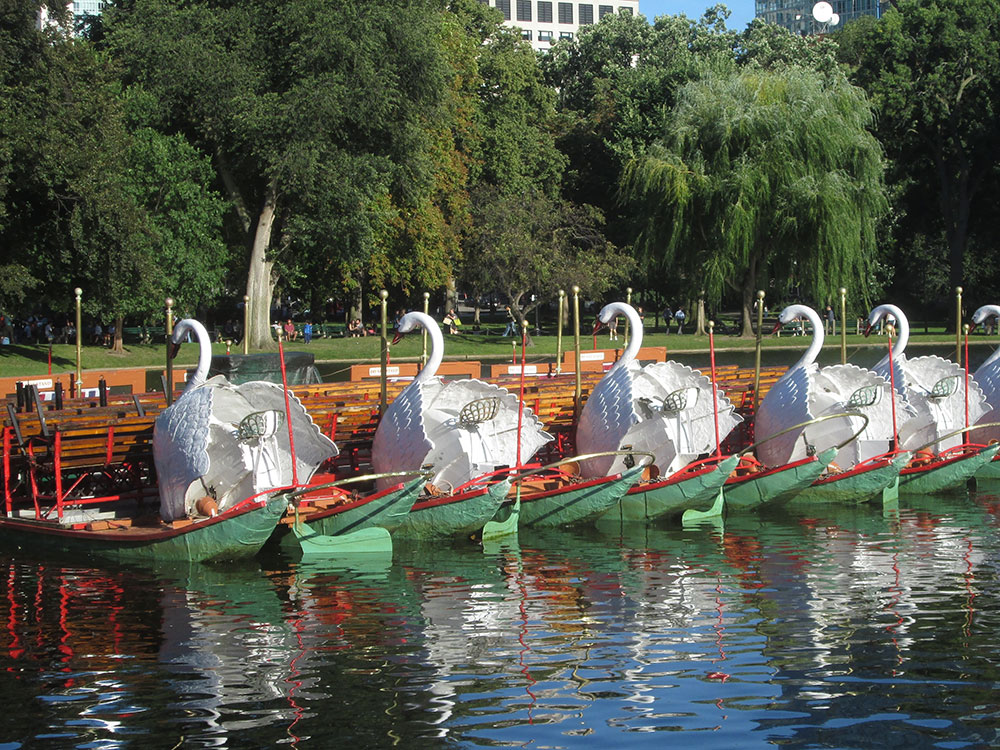
During the warmer seasons, the 4 acres (16,000 m2) pond is the home of a great many ducks, as well as of one or more swans. A popular tourist attraction is the Swan Boats, which began operating in 1877. For a small fee, tourists can sit on a boat ornamented with a white swan at the rear. The boat is then pedaled around the pond by a tour guide sitting within the swan.
Being no more than three feet deep at its deepest point, the pond easily freezes during the colder months.
Permanent flower plantings in the garden include numerous varieties of roses, bulbs, and flowering shrubs. The beds flanking the central pathway are replanted on a rotating schedule throughout the year, with different flowers for each season from mid-spring through early autumn. Plantings are supplied from 14 greenhouses the city operates at Franklin Park for the purpose.
The Public Garden is planted with a wide assortment of native and introduced trees; prominent among these are the weeping willows around the shore of the lagoon and the European and American elms that line the garden's pathways, along with horse chestnuts, dawn redwoods, European beeches, ginkgo trees, and one California redwood.
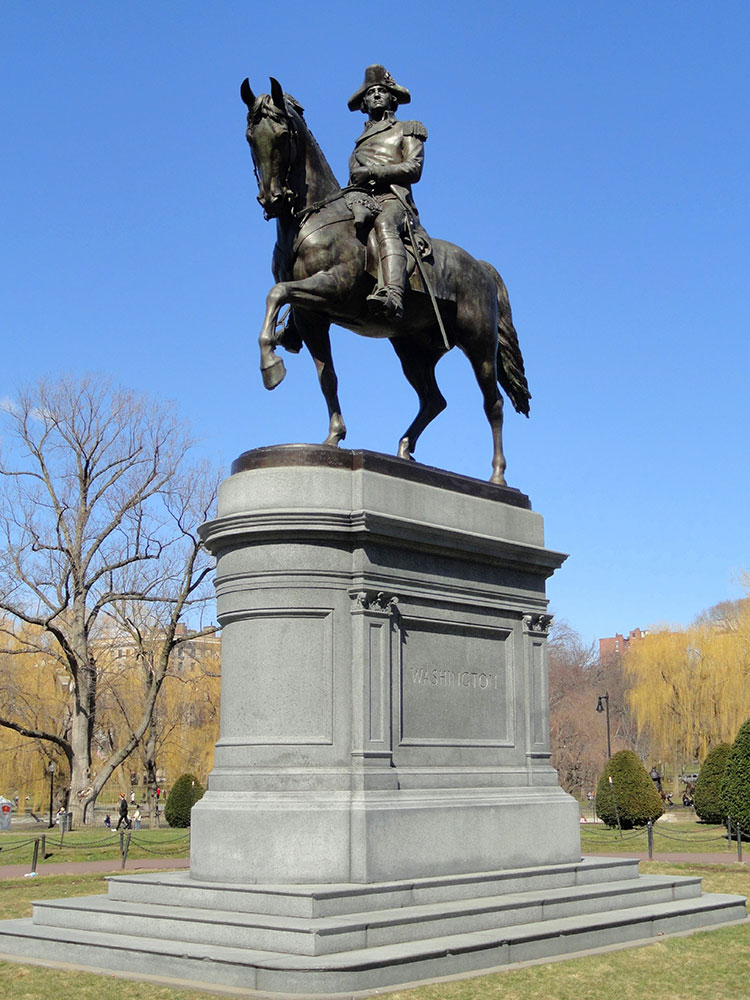
Located at the Arlington Street gate and facing Commonwealth Avenue is the equestrian statue of George Washington, designed and cast by Thomas Ball. Unveiled on July 3, 1869, the statue itself is 16 feet tall and made of bronze, and stands upon a granite pedestal of 16 feet (4.9 m), for a total height of 38 feet (12 m). The statue was funded mostly by donations from local citizens, and was constructed entirely by Massachusetts artists and artisans.
Just north of the Equestrian Statue is Mary E. Moore's "Small Child Fountain".
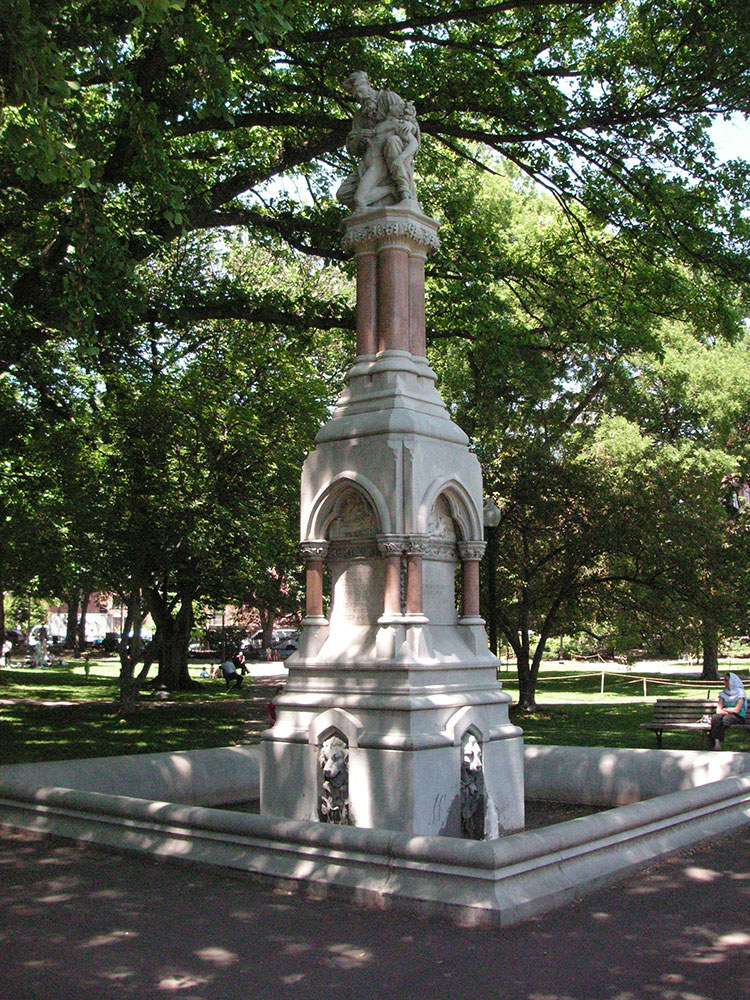
The Ether Monument, located towards the corner of Arlington and Beacon streets in the northwest corner of the garden, commemorates the first use of ether as an anesthetic. Designed by John Quincy Adams Ward and gifted to the city on June 27, 1868, by Thomas Lee, it is the oldest monument in the garden. Standing 30 feet tall and made of granite and red marble, the statue's carved figures tell the Parable of the Good Samaritan.
Just north of the Ether Monument is Daniel Chester French and Henry Bacon's memorial fountain to the Boston philanthropist George Robert White entitled "The Angel of the Waters", created in 1924. Constructed of granite and bronze, the fountain was disabled in the 1980s and remained so until 2016 when it was repaired and restored by the Friends of the Public Garden.
The first statue in the Garden that was made by a woman was Anna Coleman Ladd's Triton Babies Fountain on the east side of the garden. Though some people think the children are a boy and girl, they are in fact her two daughters. It was acquired by the garden in 1927.
Bashka Paeff's "Boy and Bird", in the fountain on the west side of the garden, was made by a Russian immigrant who did the model of it while she was working as a ticket taker at the Park Street Station of the MBTA.
Lillian Saarinen's fountain piece, "Bagheera", a dynamic statue of the panther from Kipling's Jungle Book, is nearly hidden by a tree.
A set of bronze statues by Nancy Schön, dating from 1987 and based on the main characters from the children's story Make Way for Ducklings is located between the pond and the Charles and Beacon streets entrance.
At the east gate on Charles Street is a bronze statue of Edward Everett Hale by Bela Pratt, and presented to the city on May 22 of 1913.
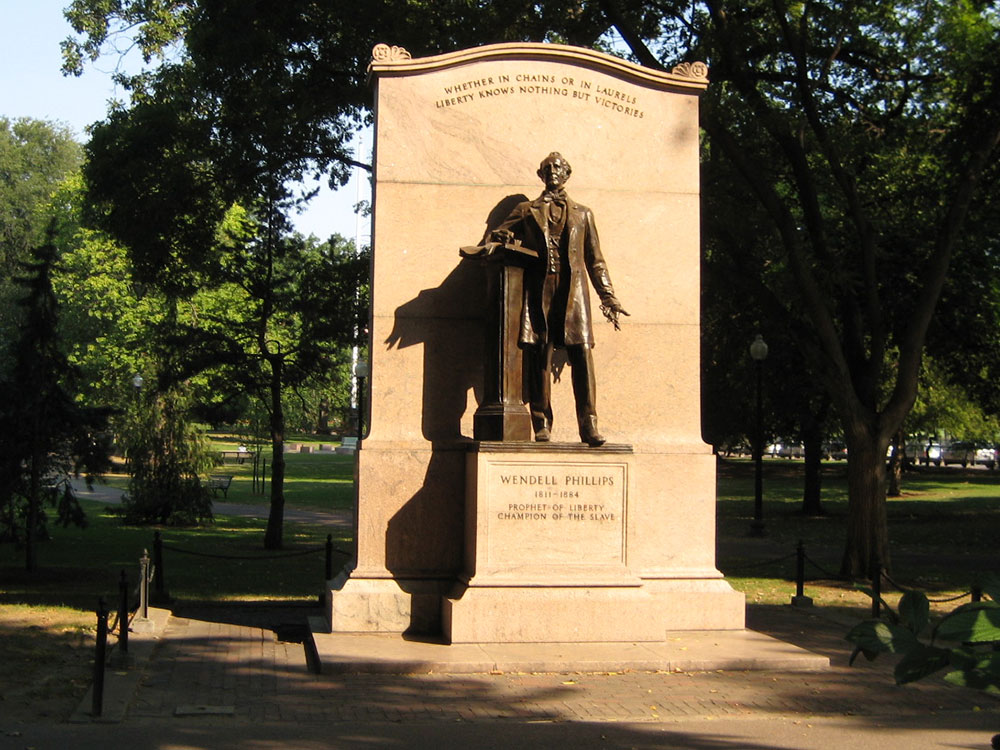
Along the south walk in the park is a statue erected in 1915 of Wendell Phillips (1811-1884), an orator and abolitionist. Mayor John F. Fitzgerald appropriated funds for the statue, which was designed by Daniel Chester French.
Colonel Thomas Cass, commander of the 9th Regiment Massachusetts Volunteer Infantry which served in the American Civil War is also memorialized on the south walk. The statue was erected in 1899.
Next to the statue of Cass is Thomas Ball's statue of Charles Sumner, a senator from Massachusetts during the Civil War era. This statue was constructed in 1878.
The walk also has a statue of Tadeusz Kościuszko, a Polish citizen who fought in the American Revolution as a colonel. The statue was erected by artist Theo Alice Ruggles Kitson in 1927.
A statue of William Ellery Channing stands at the southwest corner of the garden, facing the Arlington Street Church. Completed in June 1903 by Herbert Adams, it was given to the city by John Foster, a member of that church, and placed in its location at his request.
The Boston Public Garden Foot Bridge crossing the lagoon, designed by William G. Preston, opened June 1, 1867. It was the world's shortest functioning suspension bridge before its conversion to a girder bridge in 1921. Its original suspension system is now merely decorative.
A Japanese garden lantern dating from 1587 was gifted to Boston by Bunkio Matsuki and installed at the edge of the pond in 1906. One of the oldest lanterns of its kind in existence, it was originally in the garden of the Momoya palace at Kyoto and is made of cast iron.
In July 2004 a memorial was dedicated to the 206 people from Massachusetts who died in the September 11, 2001, terrorist attacks. Designed by Victor Walker, it is located just inside the Public Garden, at the corner of Arlington and Newbury streets.
At the beginning of the bridge by the steps leading to the Swan Boats is a plaque honoring United States Marine Lt. Michael P. Quinn, of Charlestown, killed in action in Vietnam on August 29, 1969. The plaque was dedicated by the committee members of the Michael P. Quinn Scholarship Fund on Patriots Day in 1986.
This article uses material from the Wikipedia article "Boston Public Garden", which is released under the Creative Commons Attribution-Share-Alike License 3.0

-1000.jpg)
.jpg)