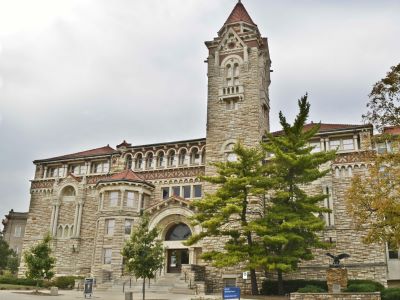

Four-floor museum showcasing fossils, wildlife dioramas, live animals, biodiversity exhibits, and one of the world's largest panoramic displays of North American habitats.
General Information
- Hours:
- Tuesday to Saturday: 9am to 5pm
Sunday: 12pm to 4pm
Closed Monday - Fees:
-
Suggested contribution: Adults $7
Suggested contribution: Children $4
KU students: Free
Museum members: Free - Pet Policy:
- Pets are not allowed
- Closest cities with hotels:
- Lawrence (0 mi)
- Seasons:
- All year
- Location:
- 1345 Jayhawk Blvd, Lawrence, KS 66045
- Website:
- biodiversity.ku.edu
How to Get There
From Downtown Lawrence (1 mi): Take Massachusetts Street north to Jayhawk Boulevard, enter the University of Kansas campus, and continue west to Dyche Hall at 1345 Jayhawk Boulevard.
Overview
The KU Natural History Museum occupies the landmark Dyche Hall on the University of Kansas campus and is the visible face of the KU Biodiversity Institute.
Fossils and Biodiversity
Galleries feature fossils from the ancient seas that once covered Kansas, interactive exhibits on biodiversity, and live reptiles and insects.
Panorama of North American Wildlife
The architectural centerpiece is the Panorama of North American Wildlife, an expansive display developed from exhibits at the 1893 World's Columbian Exposition in Chicago.
History
The museum is housed in Dyche Hall, built in 1903. Lewis Lindsay Dyche's Panorama of North American Plants and Animals, shown at the 1893 World's Columbian Exposition, is its centerpiece. It also displays Comanche, a horse that survived the Battle of the Little Bighorn.
Things to Do
See the Panorama
The 1893 diorama shows North American wildlife.
See Comanche
The preserved horse survived Little Bighorn.
See the Fossils
Fossils include a mosasaur.
See the Live Animals
Live snakes and bees are on display.
This article uses material from the Wikipedia article for the University of Kansas Natural History Museum and official information from the KU Biodiversity Institute and Natural History Museum, which includes content released under the Creative Commons Attribution-Share-Alike License 3.0.

