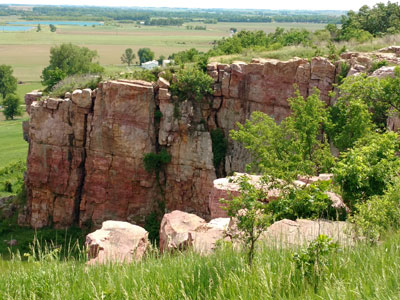

State park protects an American bison herd which grazes on one of the state's largest prairie remnants
General Information
How to Get There
From Sioux Falls, SD (30 mi): Take I-90 E from Sioux Falls approximately 25 miles to Exit 12 for US-75 N, then head north on US-75 and follow signs to the park entrance at 1410 161st St.
Overview
Blue Mounds State Park is a state park of Minnesota, in Rock County near the town of Luverne. It protects an American bison herd which grazes on one of the state's largest prairie remnants.
The state park is named after a linear escarpment of Precambrian Sioux Quartzite bedrock, which although pink in color, is said to have appeared blueish in the distance to early settlers. Parts of the cliff are up to 100 feet (30 m) high. Unusual in the surrounding prairie landscape, they are a popular site for rock climbing.
The park also preserves a 1,250-foot-long (380 m) line of rocks aligned by Plains Indians which marks where the sun rises and sets on the spring and fall equinoxes. It also has a small reservoir for swimming, the only lake in Rock County. The park's interpretive center was once the home of the author Frederick Manfred.
Four structures and one building in the park, built by the Works Progress Administration in the 1930s, are listed on the National Register of Historic Places.
Things to Do
Experience Southwestern Minnesota's Prairie Landscape
Blue Mounds State Park is one of Minnesota's most unique natural destinations, located in the state's prairie region near Luverne. The park is named for a striking 100-foot-high quartzite cliff known as the Blue Mounds, which appears bluish in color from a distance. The park protects native tallgrass prairie, dramatic rock formations, and one of Minnesota's most important bison conservation herds.
See the American Bison Herd
One of the park's signature attractions is its herd of American bison. Visitors can often observe these iconic animals grazing on the restored prairie from designated viewing areas and roadways. The herd helps preserve the natural ecology of the tallgrass prairie ecosystem while providing visitors with a rare wildlife viewing opportunity.
Explore the Blue Mounds Cliffline
The park's quartzite cliffs extend for more than a mile and provide spectacular views of the surrounding prairie landscape. The cliffs are among the oldest exposed rock formations in Minnesota and create a dramatic backdrop for hiking, photography, and sightseeing.
Discover Prairie Wildflowers and Wildlife
Blue Mounds State Park contains one of the largest remnants of native tallgrass prairie in Minnesota. During spring and summer, visitors can enjoy colorful displays of wildflowers along with opportunities to see prairie birds, butterflies, deer, and other wildlife adapted to this unique habitat.
Enjoy Camping and Outdoor Recreation
The park offers hiking, camping, rock climbing, photography, stargazing, wildlife observation, snowshoeing, and cross-country skiing. Its open landscapes and dark skies make it a popular destination for both daytime exploration and nighttime astronomy.
Top Trails
Upper Cliffline Trail
Length: Approximately 1.5 miles round trip
Elevation Gain: Moderate
Difficulty: Easy to Moderate
This scenic trail follows the top of the quartzite cliffs and offers panoramic views of the prairie below. It is one of the park's most popular hikes and an excellent location for photography and wildlife viewing.
Lower Cliffline Trail
Length: Approximately 2 miles round trip
Elevation Gain: Minimal
Difficulty: Easy
Traveling along the base of the cliffs, this trail provides a close-up look at the quartzite formations and prairie habitats. Visitors can observe unique plant communities and enjoy a different perspective of the Blue Mounds landscape.
Mound Creek Trail
Length: Approximately 3 miles loop
Elevation Gain: Moderate
Difficulty: Moderate
This trail passes through native prairie and woodland environments while offering opportunities to view wildflowers, birds, and other wildlife. It highlights the ecological diversity found within the park.
Prairie Trail System
Length: More than 6 miles of interconnected trails
Elevation Gain: Moderate
Difficulty: Easy to Moderate
The park's extensive trail network allows visitors to explore prairie landscapes, scenic overlooks, bison viewing areas, and natural habitats while experiencing one of Minnesota's finest examples of preserved tallgrass prairie.
Sources: Minnesota Department of Natural Resources official Blue Mounds State Park information, including details on the bison herd, prairie ecosystems, quartzite cliffs, hiking trails, camping, wildlife viewing, and recreational opportunities. https://www.dnr.state.mn.us/state_parks/park.html?id=spk00121
Additional information verified through Minnesota DNR visitor resources covering the Upper Cliffline Trail, Lower Cliffline Trail, prairie restoration efforts, bison management program, and outdoor recreation opportunities throughout Blue Mounds State Park.
The park is home to a small population of coyotes and deer as well as various birds.
In 1989 the WPA developments were listed on the National Register of Historic Places as a 60-acre (24 ha) historic district. The district contains five contributing properties—four structures and one building: Upper Dam, Upper Mound Lake, Lower Dam, Lower Mound Lake (all created in 1938) and a latrine (built 1939–42) located by the current cart-in campground. They are considered historically significant as examples of New Deal federal work relief and recreational development in southwestern Minnesota, and architecturally significant for their unique National Park Service rustic design using Sioux Quartzite. The two dams are particularly noteworthy, blending into the natural rock walls of the creek, an exceptional application of rustic style to utilitarian structures.
This article uses material from the Wikipedia article "Blue Mounds State Park", which is released under the Creative Commons Attribution-Share-Alike License 3.0


