
Historic river city known for its educational institutions, thriving arts scene, scenic riverfront, and role as a regional center for culture, innovation, and commerce.
General Information
- Hours:
-
Open year-round
Individual attractions, museums, businesses, and parks maintain their own operating hours - Fees:
-
Free to visit the city
Individual attractions, events, museums, and activities may charge admission - Pet Policy:
- Pets are generally permitted in public outdoor areas; policies vary by park, attraction, hotel, and business
- Closest cities with hotels:
- South Bend, IN (0 mi)
Mishawaka, IN (4 mi)
Elkhart, IN (17 mi) - Seasons:
- Spring, summer, fall, and winter
Fall football season and autumn foliage are especially popular - Location:
- South Bend, IN 46601
- Website:
- southbendin.gov
How to Get There
From Mishawaka (4 mi): Take Main Street or Lincoln Way west into downtown South Bend and continue toward the St. Joseph River corridor, where many of the city's principal attractions, hotels, and cultural venues are located.
Overview
South Bend, Indiana, sits at the southernmost bend of the St. Joseph River in the north-central part of the state, and it is best known as the home of the University of Notre Dame and its Fighting Irish football team. It is also known for the Studebaker company, which made wagons and automobiles here for more than a century, and for its revitalized downtown along the river. The city is the fourth-largest in Indiana and has a distinct college-town energy, especially on football weekends.
Visitors come to South Bend to tour the University of Notre Dame campus, to see the Golden Dome and the Basilica of the Sacred Heart, and to attend a game at Notre Dame Stadium. They also visit the Studebaker National Museum, the East Race Waterway, and the Potawatomi Zoo, and it is about 90 miles from Chicago and near Lake Michigan beaches, Amish country, and Indiana Dunes National Park.
History
French explorers, including La Salle, passed through the area in the seventeenth century, and the fur trader Pierre Navarre established a trading post here in 1820. The city was laid out in the 1820s and 1830s and was named for the bend in the river, and the Studebaker brothers opened a wagon shop in 1852 that became one of the largest vehicle makers in the world. Father Edward Sorin and several Holy Cross brothers founded the University of Notre Dame in 1842 on land north of the city. Studebaker closed its South Bend factories in 1963, and the city went through a period of decline before reinventing itself with a revitalized downtown, healthcare and education industries, and a new tech sector.
Sightseeing and Popular Landmarks
The University of Notre Dame campus is the biggest attraction, with the Golden Dome atop the Main Building, the Basilica of the Sacred Heart, the Grotto, and Touchdown Jesus on the Hesburgh Library. The Studebaker National Museum has historic vehicles, including a carriage used by Abraham Lincoln, and downtown South Bend has the East Race Waterway, an artificial whitewater course, as well as the Morris Performing Arts Center. The Potawatomi Zoo, the oldest zoo in Indiana, and the Northern Indiana Center for History are also popular.
Culture and Museums
The Snite Museum of Art, now the Raclin Murphy Museum of Art at Notre Dame, has a large art collection, and the Studebaker National Museum covers the history of the company and the automobile. The Northern Indiana Center for History has exhibits on the area's past, and the South Bend Museum of Art shows contemporary work. The Morris Performing Arts Center, the Palais Royale ballroom, and the Debartolo Performing Arts Center host concerts and performances, and the South Bend Symphony Orchestra performs regularly.
Parks
The campus lakes, Saint Joseph's Lake and Saint Mary's Lake, are scenic places for walking. The St. Joseph River Trail and the East Bank Trail run along the river downtown, and Potawatomi Park, Pinhook Park, and St. Patrick's County Park have trails, gardens, and recreation areas. Lake Michigan beaches and Indiana Dunes National Park are about 45 minutes away.
Seasons and Weather
South Bend has a humid continental climate with four seasons and is influenced by Lake Michigan. Summers are warm and humid, with highs in the 80s°F, and winters are cold and snowy, with highs in the 30s°F and about 65 inches of lake-effect snow. Fall is a popular time to visit because of football and the fall colors, and spring and early summer are pleasant for walking on campus and along the river.
This article uses material from Wikipedia as well as information from official tourism and institutional sources. Key references include Visit South Bend Mishawaka, University of Notre Dame, Studebaker National Museum, Potawatomi Zoo, and National Weather Service Northern Indiana. Wikipedia material is from the articles "South Bend, Indiana" and "University of Notre Dame", and is available under the Creative Commons Attribution-Share-Alike License 3.0.
Featured Locations

Jonathunder, CC BY-SA 3.0, via Wikimedia Commons; Image Size Adjusted

Basilica of the Sacred Heart
Gothic-style church featuring intricate stained glass, ornate murals, and a towering spire that exemplifies 19th-century ecclesiastical architecture.
Jonathunder, CC BY-SA 3.0, via Wikimedia Commons; Image Size Adjusted
Saint Joseph’s Lake
Freshwater lake with a wooded walking trail, seasonal beach access, and scenic views that offer a peaceful retreat for recreation and reflection.
Jonathunder, CC BY-SA 3.0, via Wikimedia Commons; Image Size Adjusted
Saint Mary’s Lake
Spring-fed lake surrounded by wooded trails and scenic views, offering a peaceful setting for walking, birdwatching, and quiet reflection.

Jeff P from Berkeley, CA, USA, CC BY 2.0, via Wikimedia Commons; Image Size Adjusted

Studebaker National Museum
Three-level museum featuring historic carriages, classic automobiles, and military vehicles that trace the evolution of American transportation and craftsmanship.
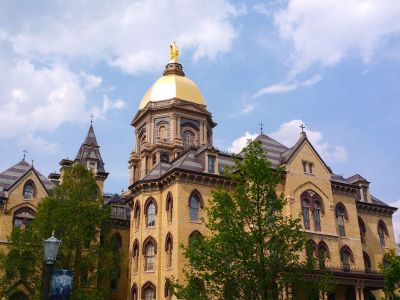
Jeff P from Berkeley, CA, USA, CC BY 2.0, via Wikimedia Commons; Image Size Adjusted
University of Notre Dame
Prestigious Catholic research university known for its iconic architecture, academic excellence, and vibrant campus life centered around tradition and community.