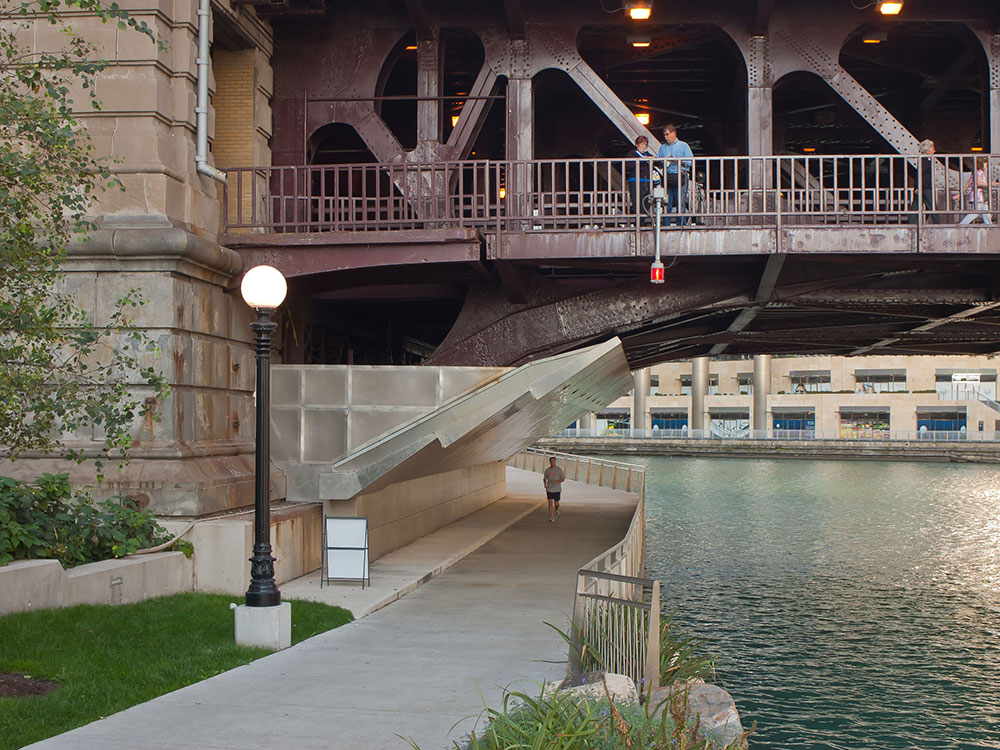
Bascule bridge that carries Michigan Avenue across the main stem of the Chicago River in downtown Chicago.
General Information
- Hours:
- Open 24 hours daily
- Fees:
-
Admission: Free
Pedestrian access: Free - Pet Policy:
- Leashed pets are permitted on public sidewalks and walkways crossing the bridge.
- Closest cities with hotels:
- Chicago, IL
- Seasons:
- All year (Spring through Fall offers the best weather and river activity, while winter provides unique city skyline views)
- Location:
- Michigan Ave. and the Chicago River, Chicago, IL 60611
- Website:
- choosechicago.com
How to Get There
From Chicago, IL: Travel along North Michigan Avenue toward the Chicago River and continue to DuSable Bridge, which connects the Magnificent Mile with the Loop at the intersection of Michigan Avenue and East Wacker Drive.
Overview
The DuSable Bridge (formerly the Michigan Avenue Bridge) is a bascule bridge that carries Michigan Avenue across the main stem of the Chicago River in downtown Chicago. The bridge was proposed in the early 20th century as part of a plan to link Chicago's south side and north side parks with a grand boulevard. Construction of the bridge started in 1918, it opened to traffic in 1920, and decorative work was completed in 1928. The bridge provides passage for vehicles and pedestrians on two levels. An example of a fixed trunnion bascule bridge (which is also known as a "Chicago style bascule bridge"), it may be raised to allow tall ships and boats to pass underneath. The bridge is included in the Michigan-Wacker Historic District and has been designated as a Chicago Landmark.
The location is significant in the early history of Chicago, connecting on the north near the 1780s homestead site of Jean Baptiste Point du Sable and on the south the early 19th century site of Fort Dearborn. Events from the city's past are commemorated with sculptures and plaques on the bridge, and exhibits in the McCormick Bridgehouse & Chicago River Museum—housed in one of the bridge tender houses—detail the history of the Chicago River.
Location
The Michigan Avenue Bridge has a north-south orientation, spanning the main stem of the Chicago River between the Near North Side and Loop community areas of Chicago. Its northern portal lies at the foot of the Magnificent Mile, between the Wrigley Building and Tribune Tower. Its southern portal is at the intersection of Michigan Avenue and Wacker Drive, overlooked by the London Guarantee Building and 333 North Michigan. The neighboring bridges are Columbus Drive Bridge to the east and Wabash Avenue Bridge to the west.
The bridge is situated in a historically significant area. The northern end of the bridge covers part of the Jean Baptiste Point Du Sable Homesite, which is commemorated by a National Historic plaque in Pioneer Court. The southern half of the bridge passes over the site of Fort Dearborn, which was constructed in 1803. The Fort is commemorated by a large relief above the entrance of the London Guarantee Building, and brass markers positioned in the sidewalks on the south side of the bridge delineate the posited outline of the original blockhouse.
Name
In October 2010, the bridge was renamed DuSable Bridge in honor of Jean Baptiste Point du Sable, Chicago's first permanent resident. A fur trader of African descent who married into the Potawatomi tribe, he established a permanent homestead and trading post near the mouth of the Chicago River in the 1780s.
Decoration
In 1928, sculptures depicting scenes from Chicago's history were added to the outward-facing walls of the four bridgehouses. The sculptures on the northern bridgehouses were commissioned by William Wrigley Jr. and made by James Earle Fraser: The Discoverers depicts Louis Joliet, Jacques Marquette, René-Robert Cavelier, Sieur de La Salle and Henri de Tonti; The Pioneers depicts John Kinzie leading a group through the wilderness. The sculptures on the southern bridgehouses were commissioned by the Benjamin F. Ferguson Monument Fund, and are by Henry Hering: Defense depicts Ensign George Ronan in a scene from the 1812 Battle of Fort Dearborn; Regeneration depicts workers rebuilding Chicago after the Great Chicago Fire of 1871.
The bridge is also bedecked with 28 flagpoles, usually flying the flags of the United States, Illinois and Chicago. On special occasions other banners may be displayed.
McCormick Bridgehouse & Chicago River Museum
The southwest bridgehouse has been converted into a museum, with its entrance off the Chicago Riverwalk. The McCormick Bridgehouse & Chicago River Museum is a 5-floor, 1,613-square-foot (149.9 m2) museum that opened on June 10, 2006; it is named for Robert R. McCormick, formerly owner of the Chicago Tribune and president of the Chicago Sanitary District. It is run by the Friends of the Chicago River, and includes exhibits on the history of the Chicago River and the bridge. Visitors are also allowed to access the bridge's gear room; during the spring and fall bridge lifting, visitors can see the bridge gears in operation as the leaves are raised and lowered. Due to its small size and tight access stairway, only 79 people are allowed inside the museum at any one time.
This article uses material from the Wikipedia article "DuSable Bridge", which is released under the Creative Commons Attribution-Share-Alike License 3.0