
Nationally recognized historic residential district containing one of the largest concentrations of Prairie School architecture, with dozens of architecturally significant homes designed by Frank Lloyd Wright and his contemporaries.
General Information
- Hours:
- Open daily, 24 hours for self-guided exterior viewing
- Fees:
- Free to explore the district; guided tours are available separately through local tour providers
- Pet Policy:
- Leashed pets are permitted on public sidewalks and streets; pets are not allowed on private property without permission
- Closest cities with hotels:
- Oak Park (1 mi)
- Seasons:
- All year; spring, summer, and fall are best for walking tours and architectural sightseeing
- Location:
- Frank Lloyd Wright Historic District, Oak Park, IL
- Website:
- oakparkandbeyond.org
How to Get There
From Oak Park (1 mi): Follow local streets toward the neighborhood bounded generally by Division Street, Lake Street, Ridgeland Avenue, and Marion Street to reach the historic district and its collection of landmark Prairie School homes.
Overview
The Frank Lloyd Wright-Prairie School of Architecture Historic District is a residential neighborhood in Oak Park, Illinois, protecting more than 80 buildings, over 25 of them designed by Frank Lloyd Wright himself, widely regarded as the greatest American architect, alongside work by his early Prairie School followers.
History
Wright moved to Oak Park in 1889, building his home and, in 1897, an adjoining studio, and went on to design buildings here spanning several decades of his career, from some of his earliest work through his "first mature period." The district was locally designated in 1972 and added to the National Register of Historic Places in 1973.
Architecture
Notable Wright designs in the district include the Nathan G. Moore Residence, Arthur Heurtley House, and Frank Thomas House, alongside earlier 1860s Italianate and 1920s Revival-style buildings.
This article uses material from the Wikipedia article "Frank Lloyd Wright-Prairie School of Architecture Historic District", which is released under the Creative Commons Attribution-Share-Alike License 3.0
Featured Locations

Jeff P from Berkeley, CA, USA, CC BY 2.0, via Wikimedia Commons; Image Size Adjusted
Arthur Heurtley House
National Historic Landmark designed by Frank Lloyd Wright showcasing early Prairie School architecture with distinctive horizontal lines, art glass windows, and innovative residential design.
Jeff P from Berkeley, CA, USA, CC BY 2.0, via Wikimedia Commons; Image Size Adjusted
Edward R. Hills House
Historic Frank Lloyd Wright-remodeled residence blending Victorian and Prairie School design elements, recognized as a landmark for its architectural significance and meticulous restoration.
Jeff P from Berkeley, CA, USA, CC BY 2.0, via Wikimedia Commons; Image Size Adjusted
Frank Lloyd Wright Home and Studio
Historic home and architectural studio where Frank Lloyd Wright developed the Prairie School style and designed many of his earliest and most influential works.
Jeff P from Berkeley, CA, USA, CC BY 2.0, via Wikimedia Commons; Image Size Adjusted
Frank Thomas House
Prairie-style residence recognized as one of Frank Lloyd Wright’s first fully mature residential designs, featuring innovative horizontal forms, art glass details, and a groundbreaking open architectural composition.
Jeff P from Berkeley, CA, USA, CC BY 2.0, via Wikimedia Commons; Image Size Adjusted
Laura Gale House
Prairie School residence featuring dramatic cantilevered forms, geometric design, and innovative architectural elements that helped shape the development of modern residential architecture.
Jeff P from Berkeley, CA, USA, CC BY 2.0, via Wikimedia Commons; Image Size Adjusted
Nathan G. Moore House
Historic Tudor Revival residence designed and later redesigned by Frank Lloyd Wright, distinguished by its steep gabled roofs, intricate ornamentation, and unique blend of traditional and modern architectural influences.
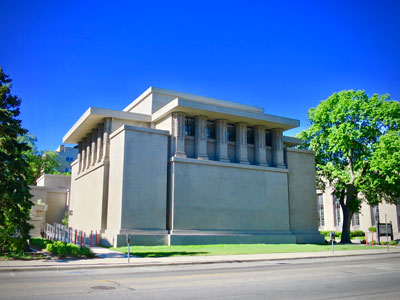
Brian Crawford from Oak Park, IL, USA, CC BY-SA 2.0, via Wikimedia Commons; Image Size Adjusted

Unity Temple
Church designed by architect Frank Lloyd Wright, is considered to be one of Wright's most important structures dating from the first decade of the twentieth century


