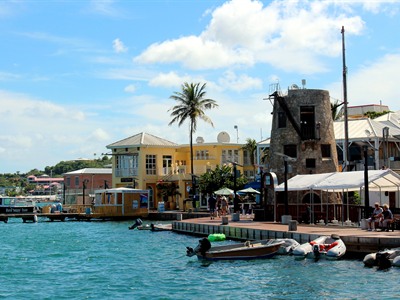
Begin your morning at Christiansted National Historic Site, which preserves a cluster of 18th-century Danish colonial buildings along the harbor. Fort Christiansvaern, the yellow fort completed in the 1700s, is the centerpiece, and its rooms, courtyard, and ramparts give a sense of what life was like for soldiers stationed here. The old customs house, scale house, and Steeple Building are nearby, and together they tell the story of the sugar trade and the island's enslaved population.
St. Croix: Danish Forts, Sugar Mills, Coral Reefs, and the Easternmost Point of the United States
3 Days
St. Croix is the largest of the U.S. Virgin Islands and the most laid-back, with a mix of history, rural landscapes, and Caribbean beaches. Christiansted, on the north shore, and Frederiksted, on the west end, are both Danish colonial towns with forts and pastel waterfronts, and between them lie rolling hills, old sugar estates, and rum distilleries. Offshore, Buck Island Reef National Monument protects some of the best snorkeling in the territory, and the island's wall and wreck dives draw divers from around the world. This three-day itinerary spends the first day in Christiansted with a snorkeling trip to Buck Island, the second on the east end and north shore, and the third in the west around Frederiksted. A car is essential, and driving is on the left.
Day 1
The first day starts in Christiansted, whose historic waterfront has been preserved as a national historic site. The town is compact and easy to explore on foot, and the afternoon is reserved for a boat trip to Buck Island, so book your tour in advance, since boats depart from the Christiansted waterfront.
1
2
Walk along the Christiansted Boardwalk, the waterfront promenade that runs past sailboats, seaplanes, and historic buildings. Arcaded walkways shelter small shops, galleries, and restaurants, and the harbor view is one of the island's most photographed. It is a pleasant place to have lunch before heading out on the water.
3
In the afternoon, take a half-day boat trip to Buck Island Reef National Monument, a small uninhabited island about 1.5 miles off the north coast. An underwater trail leads snorkelers through elkhorn coral, schools of tropical fish, and sea turtles, and the beach on the island's west side is one of the finest in the Caribbean. Most tours include snorkel gear, a beach stop, and a short hike to a hilltop viewpoint. Return to Christiansted for dinner.
Day 2
Today explores the east end and the north shore, which are the most scenic parts of the island. Distances are short, but the roads are winding, so give yourself time. Plan to finish with a night kayak tour if you want to see the bioluminescent bay.
1
Start early at Point Udall, the easternmost point of the United States, where rugged cliffs fall away to the sea. The windswept headland is the first place in the country to see the sunrise each day, and the views stretch across the Caribbean in every direction. A short walk leads to the Millennium Monument, a sundial that marks the new millennium.
2
Drive across the island to Salt River Bay, a protected harbor of mangroves, estuaries, and coral reefs. It is one of the most historically significant places in the territory, and the only known site in U.S. territory where Christopher Columbus's expedition landed in 1493. Walk the trails, visit the archaeological sites, or paddle through the mangroves.
3
Spend the afternoon on Cane Bay Beach, a palm-lined strip of sand on the north shore that is famous for its dramatic drop-off just offshore. Snorkelers can explore the reef close to the beach, and divers swim out to the wall where the seafloor plunges thousands of feet. Beach bars and restaurants line the road, making it an easy place to relax.
4
After dark, join a guided kayak tour on the bioluminescent bay near Salt River. Microscopic marine organisms glow blue whenever the water is disturbed, so every paddle stroke and every splash lights up the bay. Tours are best on nights with little moonlight; book ahead and bring insect repellent.
Day 3
The last day explores the west end around Frederiksted, the island's second town, where sugar estates, a rum distillery, and a historic pier offer a more rural feel. Frederiksted is also known for its sunsets, so plan to finish the day at the waterfront.
1
Begin the morning at St. George Village Botanical Garden, a 16-acre garden built around the ruins of a 19th-century sugar plantation village. Shady paths wind through collections of palms, orchids, and tropical flowers, passing old stone ruins from the plantation village. It is cool and quiet in the morning, with plenty of birds.
2
Visit Estate Whim, a beautifully preserved 18th-century sugar plantation with a windmill tower, great house, and open grounds. Guided tours explain how sugar cane was grown and processed here and how the island's economy depended on enslaved labor. The museum is open on select days, so check hours before you go.
3
Take a tour of the Cruzan Rum Distillery, where rum has been produced from local sugar cane and molasses for generations. Guides walk you through the distillation and aging process, and tours end with a tasting of the distillery's rums. It is a good stop at midday, and the gift shop sells bottles that are hard to find on the mainland.
4
End the day in Frederiksted at Fort Frederik, the red Danish fort where the emancipation of the Danish West Indies was proclaimed in 1848. Then walk out along Frederiksted Pier, a historic landmark whose pilings shelter fish and corals and make it a renowned shore-diving and snorkeling spot. The pier is one of the best places on St. Croix to watch the sun set over the Caribbean.