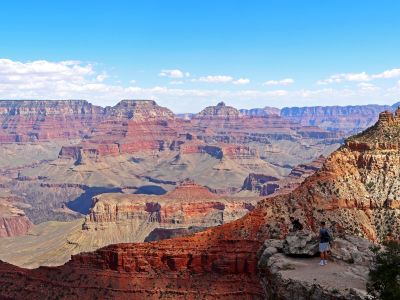
Begin your morning at the Grand Canyon Visitor Center, where rangers can share trail conditions, shuttle information, and the day's ranger programs, and exhibits introduce the canyon's geology and the many peoples who have called it home. From the visitor center plaza, it is a short, easy walk to Mather Point, the first view of the canyon for many visitors. From its broad, guard-railed overlook, the canyon stretches outward in an endless display of layered rock, deep side canyons, and towering buttes, with small glimpses of the Colorado River far below. Arriving early rewards you with softer light and smaller crowds.
Grand Canyon National Park: Iconic Overlooks and Historic Landmarks of the South Rim
1 Day
Carved by the Colorado River over millions of years, the Grand Canyon stretches 277 miles across northern Arizona, reaching depths of more than a mile and exposing nearly two billion years of Earth's history in its colorful layers of rock. The South Rim is the park's most popular and accessible area, open year-round and home to Grand Canyon Village, with iconic viewpoints, historic lodges, rim trails, and free shuttle buses. This one-day itinerary covers the heart of the South Rim, from Mather Point and Yavapai Point to the historic village and the scenic overlooks of Hermit Road, ending with sunset at Hopi Point. Desert View Drive and the Desert View Watchtower, about 25 miles east of the village, are left out to keep the day relaxed, as are hikes below the rim on the Bright Angel and South Kaibab trails, which are better suited to a longer stay.
Day 1
The day centers on Grand Canyon Village and the Rim Trail, which links the viewpoints with gentle, mostly paved paths. Park once at the visitor center and use the free shuttle buses to get around, since parking in the village fills quickly. A private vehicle pass costs $35 and is valid for 7 days. At about 7,000 feet, the rim can be cool in the mornings and evenings even in summer, so bring layers, sun protection, and plenty of water.
1
2
Follow the paved Rim Trail west from Mather Point for about 0.7 mile to Yavapai Point, one of the most expansive panoramas on the South Rim. Step inside the historic Yavapai Geology Museum, a stone observation station from the late 1920s, where a floor-to-ceiling window frames the inner canyon and exhibits explain how the canyon formed. From the windows and terrace, look for the Colorado River and the Phantom Ranch area far below. Continue west on the Trail of Time, an interpretive path that marks geologic time along the rim with rock samples from the canyon's layers, as it leads toward Grand Canyon Village.
3
Spend the middle of the day exploring the Grand Canyon Village Historic District, where landmark buildings were designed to blend with the landscape in the National Park Service Rustic style, many by architect Mary Colter. Stroll past the grand El Tovar Hotel, opened in 1905, browse Native American arts and crafts in Hopi House, and visit Kolb Studio and Lookout Studio, both perched right on the edge of the rim. Look for Buckey O'Neill Cabin, from the 1890s, the oldest surviving structure on the rim, and stop for lunch at El Tovar or Bright Angel Lodge.
4
In the afternoon, board the free Hermit Road shuttle at the Hermits Rest Route Transfer, just west of Bright Angel Lodge, since the 8-mile road is open only to shuttles and bicycles from March through December. Hop off at overlooks such as Powell Point and Mohave Point, where sheer cliffs drop thousands of feet and the Colorado River comes into view, then ride to the end of the line at Hermits Rest. Designed by Mary Colter in 1914, this rustic stone rest stop has a massive fireplace and a shaded porch with expansive west-facing views. The quieter western rim is a welcome break from the busy village.
5
End the day at Hopi Point, which projects farther into the canyon than any other viewpoint on Hermit Road and offers one of the widest panoramas on the South Rim. Look down on a long stretch of the Colorado River and across to the distant North Rim as the setting sun turns temples, buttes, and canyon walls red, orange, and gold. It is the most popular sunset spot on the west rim, so arrive early for a place along the railing and bring a warm layer, since temperatures drop quickly after dark. Check the shuttle schedule for the last bus back to the village.