
Begin at the Yankee Freedom ferry terminal on Grinnell Street in Key West, where a high-speed catamaran sets out across the Gulf of Mexico toward the Dry Tortugas. Breakfast is served on board as the last of the Keys slip behind you and the water turns ever deeper shades of blue. Keep watch from the deck for sea turtles, dolphins, and flying fish. The ferry package also includes lunch, snorkel gear, and a guided fort tour, making it the simplest way to experience the park. Travelers short on time can instead take a seaplane, a scenic flight of about 40 minutes that offers aerial views of the fort and reef.
Dry Tortugas National Park: Fort Jefferson, Coral Reefs, and the Edge of the Florida Keys
1 Day
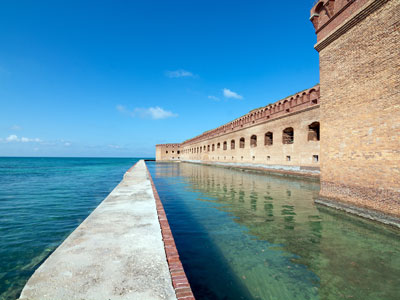
Seventy miles west of Key West, where the Florida Keys finally give way to open sea, Dry Tortugas National Park rises from the water as one of the most remote and unforgettable places in the national park system. More than 99 percent of the park is water, and at its heart stands Fort Jefferson, a massive, never-finished brick fortress built of more than 16 million bricks and surrounded by a moat of brilliant turquoise. Because the park can be reached only by ferry, seaplane, or private boat, nearly every visitor experiences it as a day trip from Key West. This one-day itinerary follows the rhythm of the Yankee Freedom ferry excursion and focuses on Garden Key, where the fort, beaches, and best snorkeling are found. Loggerhead Key, three miles to the west, is left out because it can be reached only by private boat, and the park's smaller islands are mostly closed to visitors.
Day 1
The day begins early in Key West, followed by a crossing of about 2 hours and 15 minutes to Garden Key. Ferry passengers typically have around four hours on the island, which is just enough time to tour Fort Jefferson, walk the moat wall, and spend a relaxed stretch snorkeling and swimming before the return trip. Reserve the ferry well in advance, especially from November through April, when milder temperatures and calmer seas make this the most popular time to visit. There is little shade on the island, so bring a hat, sunscreen, and plenty of water.
1
2
Shortly after arriving on Garden Key, join the guided tour of Fort Jefferson, the largest brick masonry structure in the Western Hemisphere. Construction began in 1847 to guard the Gulf of Mexico, and the fort later served as a Civil War-era prison, most famously holding Dr. Samuel Mudd, the physician who treated John Wilkes Booth, until his pardon in 1869. Wander through the fort's arched corridors and casemates, stop at the small visitor center, and climb to the top of the walls for sweeping views of the parade ground, the moat, and the surrounding sea.
3
Step outside the fort for the island's signature walk, a flat stroll of about half a mile along the moat wall that encircles Fort Jefferson. With the brick walls rising on one side and clear turquoise water on the other, it is one of the most photogenic walks in any national park. Look down into the moat for colorful fish and the occasional sea turtle, and keep an eye on the sky for magnificent frigatebirds soaring overhead. Along the way, take in the Garden Key lighthouse atop the fort's walls and the weathered ruins of the old coaling docks.
4
After lunch on the ferry, grab your snorkel gear and wade in from the beaches of Garden Key. The best snorkeling is along the outside of the moat wall and near the old coaling dock pilings, where coral, sea fans, and schools of tropical fish gather in the clear, shallow water. Lucky snorkelers may spot green, loggerhead, or hawksbill sea turtles, or even a goliath grouper lingering in the shadows. If you would rather stay dry, the soft sand beaches are perfect for relaxing and soaking in the island's remote beauty.
5
If your visit falls between October and January, finish your time on the island with a walk to neighboring Bush Key. When a natural sandbar connects the two islands, you can follow an easy shoreline walk of about one mile round trip surrounded by brilliant blue water and views back toward Fort Jefferson. From February through September the island closes to protect the only nesting colony of sooty terns in the contiguous United States, but even then you can watch tens of thousands of terns, brown noddies, and frigatebirds from Garden Key. Afterward, return to the dock for the afternoon crossing back to Key West, often arriving in time to catch sunset at Mallory Square.